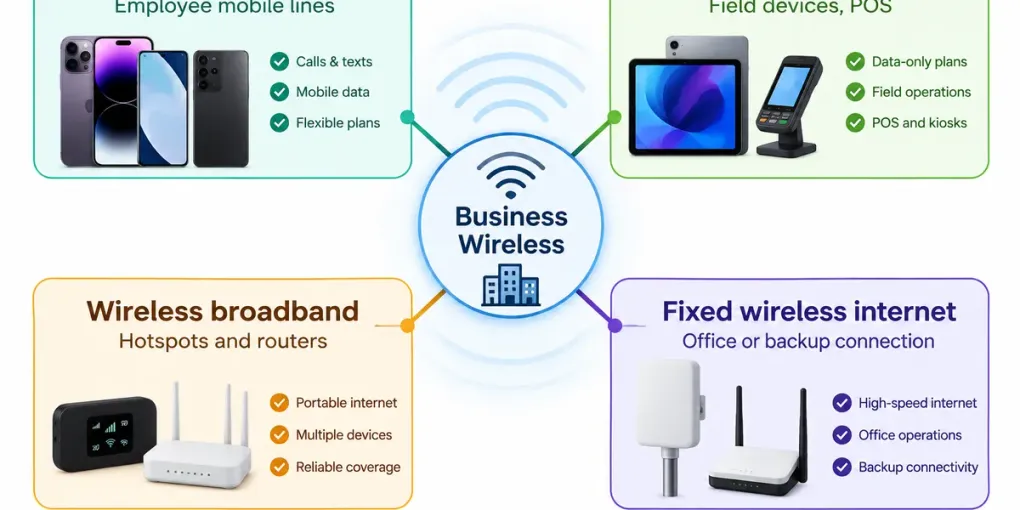
Business Wireless Plans: A Small Business Guide
Introduction
Staying connected is not optional for a small business. Whether your team is answering customer calls, checking email between job sites, or running a point-of-sale system, a dropped connection or an unreliable plan can cost you a sale, a client, or an afternoon of lost productivity.
Choosing a wireless carrier and plan for a growing team is not just about picking the most familiar name. It is about matching plan types, device options, and pricing structure to how your business actually operates day to day. This guide breaks down what business wireless plans actually offer, what to compare before choosing one, and how to think through picking the right fit.
The Problem: Why Connectivity Gets Harder to Manage as You Grow
In the early stages of a business, connectivity is usually simple: a personal phone plan, maybe one shared hotspot, and that is enough. As a team grows past a handful of people, informal setups start creating real friction.
Common pain points small business owners run into:
- Employees on separate personal plans with no centralized billing or account management
- No reliable backup connection when office internet goes down
- Field or mobile teams losing signal or getting deprioritized during busy periods
- Devices like tablets, routers, and hotspots that do not fit neatly under a phone plan
- Unpredictable monthly costs with no clear line-by-line breakdown
- Security concerns from employees handling customer data over unmanaged connections
These issues tend to surface most clearly once a business has multiple employees working outside a single fixed location, whether that is a sales team, a field service crew, or a business with more than one site.
Why This Problem Matters
Ignoring a disorganized wireless setup does not just create mild inconvenience. It creates measurable business risk.
Lost productivity. A dropped call with a client or a delayed response because someone lost signal in the field can directly cost business.
Higher costs than necessary. Separate personal plans, redundant devices, and no line-by-line visibility often mean a business pays more than it would on a single managed account.
Security exposure. Employees handling customer data or payments over unmanaged, unsecured connections increases the risk of a breach.
No continuity plan. Without a backup connectivity option, a single outage at the office can stop the business from operating for hours.
Difficulty scaling. Ad hoc connectivity that works for three employees usually breaks down by the time a team reaches ten or more, often at the worst possible moment.
None of this requires exaggeration to justify addressing it. These are practical, measurable costs that build up over time.
The Solution: What Business Wireless Plans Actually Offer
Business wireless plans are built differently than personal consumer plans. Rather than a single plan for every device, most carriers offer a family of plan types designed around how a device is actually used, including:
- Unlimited smartphone plans for employee mobile lines
- Pooled or shared data plans across a team
- Data-only plans for tablets and connected devices
- Wireless broadband and mobile hotspot plans for routers
- Fixed wireless internet for office locations without reliable wired service
The goal is to let a business match each device to the plan type it actually needs, rather than forcing every line onto one generic option. This also usually comes with centralized billing and account management, so an owner or office manager can track usage and cost across the whole team from a single account.
What to Look for in a Business Wireless Plan
Not every small business needs the same setup. Before comparing specific carriers, it helps to know which criteria actually matter for your situation.
Plan flexibility Confirm the carrier offers separate plan types for smartphones, tablets, hotspots, and routers, rather than forcing every device onto the same plan.
Network reliability and priority Look for network-level reliability and understand whether data gets deprioritized during high-traffic periods, since this affects performance when it matters most.
Pricing structure Business wireless pricing is typically per line, per month, often with the per-line cost decreasing as more lines are added. Understand what is included at each tier and what triggers extra charges.
Security features Confirm whether security is built into the network itself or requires a separate add-on, particularly important for businesses without dedicated IT support.
Bundling options Some carriers offer additional discounts when wireless is combined with business internet or fiber service, which can meaningfully lower total connectivity costs.
Coverage in your actual locations Check real coverage at your business address or job site areas rather than relying on general marketing claims, since coverage varies significantly by region.
Promotional terms Understand what conditions apply to advertised pricing, such as autopay enrollment, minimum line counts, or bundling requirements, since the advertised price is not always the price every business pays.
Only prioritize the criteria that are relevant to your business size, mobility needs, and location.
Types of Business Wireless Solutions
Rather than recommending a specific carrier, it is more useful to understand the main categories of business wireless plans available, since the right type depends heavily on how your team actually works.
1. Unlimited Smartphone Plans
Built for employee mobile lines, these plans typically include unlimited talk, text, and data with tiered options based on hotspot data, international coverage, and network prioritization.
Best for: businesses with employees who rely on smartphones for calls, navigation, email, and moderate data use throughout the day.
2. Data-Only and Tablet Plans
Separate from phone lines, these plans cover tablets, laptops, and other connected devices that need data but not voice service.
Best for: businesses using tablets for estimates, inventory, point-of-sale, or field data collection.
3. Wireless Broadband and Hotspot Plans
These plans are built around routers and mobile hotspot devices, often priced by data speed tier rather than per line.
Best for: businesses needing a primary, backup, or temporary internet connection for an office or job site without wired service.
4. Fixed Wireless Internet
A wireless alternative to traditional wired internet, useful for locations where fiber or cable is unavailable or unreliable.
Best for: businesses in areas with limited wired infrastructure, or as a backup connection for continuity planning.
Comparing the Plan Types
| Criteria | Unlimited Smartphone | Data-Only / Tablet | Wireless Broadband | Fixed Wireless Internet |
|---|---|---|---|---|
| Best for | Employee mobile lines | Tablets and connected devices | Routers and hotspots | Office or backup internet |
| Core strength | Voice and everyday mobile use | Flexible data-only coverage | Speed-tiered connectivity | Wired-alternative reliability |
| Pricing basis | Per line, per month | Per line, per month | Priced by speed tier | Priced by speed tier |
| Best fit for team size | Any size with mobile employees | Businesses using tablets in the field | Businesses needing backup or temporary connectivity | Businesses in low-infrastructure areas |
| Setup effort | Low | Low | Moderate | Moderate |
This comparison is based on general category characteristics. Actual pricing, coverage, and terms vary by carrier and region, so always verify current details directly with a provider before deciding.
How to Choose the Right Type for Your Business
Choose unlimited smartphone plans if:
- Your team primarily needs voice, text, and moderate data on the go.
- You want a family of plans that scales as you add employees.
- Centralized billing across multiple lines matters to you.
Choose data-only or tablet plans if:
- Your team uses tablets or connected devices for field work, estimates, or point-of-sale.
- You do not need voice service on every device.
- You want to avoid paying for phone-plan features you do not use.
Choose wireless broadband or hotspot plans if:
- You need a backup or temporary internet connection for an office or job site.
- Wired internet is unreliable or unavailable at a specific location.
- You prioritize flexibility over a long-term fixed setup.
Choose fixed wireless internet if:
- Your business location has limited access to fiber or cable.
- You want a wireless-based primary connection rather than just backup.
- Continuity planning is a priority and you need a dependable alternative to wired service.
Frequently Asked Questions
Do small businesses need a separate business wireless plan, or can personal plans work? Personal plans can work temporarily for very small teams, but they lack centralized billing, business-focused support, and often cost more per line as a team grows. Most businesses benefit from a dedicated plan once they have several employees relying on mobile connectivity.
Are business wireless plans more expensive than personal plans? Pricing varies by carrier and plan type, but per-line costs on business plans often decrease as more lines are added, which can make them more cost-effective for teams compared to several separate personal plans. Always confirm current pricing directly with a provider, since it changes over time.
Does unlimited data mean unrestricted speed at all times? Not necessarily. Many carriers note that data speeds may be temporarily reduced during periods of high network demand, so it is worth understanding a plan’s specific data management policy rather than assuming unlimited means unrestricted.
What is the difference between wireless broadband and fixed wireless internet? Wireless broadband plans are typically built for hotspots and routers as a flexible or temporary connection, while fixed wireless internet is positioned as a more permanent, primary internet option for a specific location.
Final Thoughts
There is no single best business wireless plan for every small business. The right choice depends on how mobile your team is, what devices need connectivity, your budget, and whether you need backup or primary internet at a fixed location. Understanding the category differences outlined above puts you in a much stronger position to evaluate specific carriers against your actual needs, rather than choosing based on marketing alone.
Natural Call to Action
Compare the plan types above against how your team actually uses connectivity day to day, and check real coverage and current pricing with a provider before committing to a multi-line plan.
Suggested Internal Links
- Best HR Software for Small Businesses
- How to Choose Business Internet for a Growing Team
- A Small Business Owner’s Guide to IT Security Basics
- Best Tools for Managing Remote Teams
Note: This article intentionally does not name a specific wireless carrier or brand. If you’d like, share the specific carrier or affiliate partner to include, and I can revise the recommended solutions and comparison table with named, individually evaluated options.